
FIELD OBSERVATION
Upstream Authority, Downstream Capacity
What Leaders Should Ask About the Flow of Decisions, Resources, Information, and Permission
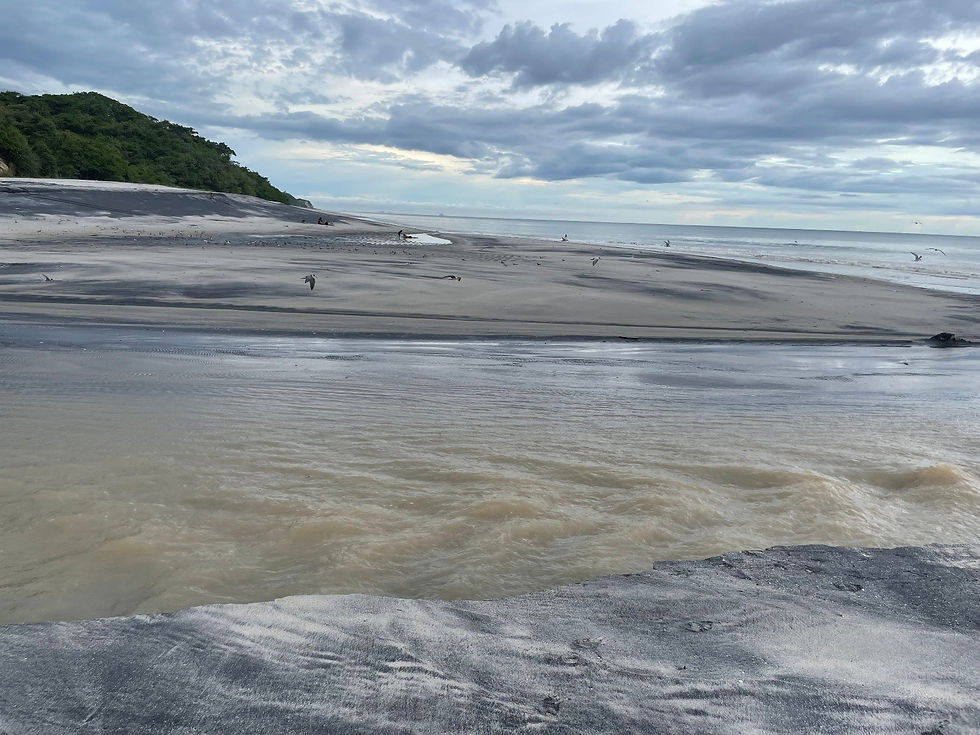
Playa Corona, Panama | October 2026
The View From Downstream

From where I first entered Playa Corona, I could see that part of the Pacific looked different. The water carried an earthy discoloration that stood apart from the surrounding ocean, but from that distance I could not see where it was coming from.
So I walked toward it.
As I moved closer, the relationship became clearer. A narrower body of water was moving across the beach toward the Pacific. What I had first encountered as a downstream condition became increasingly traceable to something occurring upstream.
I had seen the effect before I could see the system producing it.
Organizations often work the same way. Employees, customers, and frontline teams experience delayed approvals, missing information, stalled projects, unresolved cases, resource constraints, and shifting priorities long before they can see what upstream condition is producing them.
Downstream, we often see what has accumulated: delay, frustration, workarounds, disengagement, cynicism, abandoned initiatives, customer complaints, and missed opportunities.
But accumulation is evidence. It is not necessarily an explanation.
When an outcome does not make sense downstream, the diagnostic task is to begin tracing the conditions upstream.
Follow the Flow

The river changed the question I was asking.
Instead of asking only, Why does the Pacific look different here?, I could begin asking, What is flowing into it, where is that flow coming from, and what happened before it reached the ocean?
The same shift can transform organizational diagnosis.
When a project is late, a customer is waiting, an employee cannot proceed, or a transformation has stalled, attention naturally moves toward the place where the problem has become visible. Yet the location where a problem becomes visible may not be the location where it began.
Follow what the work requires.
Where does information originate? Who controls the resources? Where does approval sit? Which handoff must occur before the next person can act? What decision is waiting? What happens when that decision does not arrive at the rate the work requires?
This changes the diagnostic sequence:
Outcome → Signal → Flow → Dependency → Constraint → Intervention
Rather than treating the downstream symptom as the problem, we begin investigating the system producing it.
Authority Creates Dependency

Organizations need authority. Strategy must be established. Capital must be allocated. Risks must be governed. Certain decisions appropriately belong with people who carry broader organizational responsibility.
But every concentration of authority also creates dependency.
If ten teams require one executive's approval before proceeding, their ability to act is partially dependent upon that executive's capacity to decide. If funding must cross several organizational levels, downstream work depends upon that flow. If information is concentrated at the top, people closer to the work may have to wait for information they need to exercise judgment locally.
The problem is therefore not that authority exists upstream.
The question is whether the dependencies created by that authority are understood and intentionally designed.
What must remain upstream? What can move downstream? What requires judgment? What requires only a rule, threshold, or clearly defined decision right?
As organizations grow, yesterday's appropriate control can quietly become today's constraint.
Authority creates responsibility not only for making good decisions, but for understanding what depends upon those decisions downstream.
When Waiting Looks Like Underperformance

Years before this field observation, I encountered the organizational version of this problem while working on graduation-related projects.
My work depended upon cases moving through different stages in a student information system. Yet large numbers of cases remained in earlier statuses while the downstream graduation work depended upon their completion.
From downstream, the consequences were visible. Schools were waiting. Families needed answers. Graduation reporting still had to be completed.
But the reason work was not moving was much harder to see.
I eventually created a digital Kanban Board that brought the distribution of work across the process into view. What had appeared downstream as unfinished work could now be examined as a workflow containing queues, dependencies, handoffs, capacity constraints, and different organizational actors.
That experience taught me something I did not yet have language for:
A downstream performance problem may actually be an upstream flow problem.
When people are waiting for a decision, resource, approval, completed handoff, or critical information, lack of output does not necessarily indicate lack of capability.
Sometimes they are simply waiting.
Before asking why someone downstream has not moved, leaders should ask:
What are they waiting for—and where is it?
Waiting, observing, and being prevented from acting are three different conditions. Yet from a distance, they may look remarkably similar.
Accumulation and Deprivation

A bottleneck produces two conditions at the same time.
-
Something accumulates on one side of the constraint.
-
Something becomes scarce on the other.
In organizations, accumulation can appear as approval queues, unresolved cases, contracts awaiting review, budget requests, hiring decisions, unanswered escalations, unread reports, projects awaiting sponsorship, or decisions waiting for another meeting.
Downstream, the corresponding deprivation may be less visible: teams without permission, customers without answers, projects without resources, managers without timely information, employees without clarity, or opportunities without timely decisions.
This leads to an important diagnostic principle:
Every bottleneck creates both accumulation and deprivation.
The problem is not simply that work is waiting. It is that the resources, decisions, or information needed elsewhere in the system have not arrived.
People follow up repeatedly. Managers escalate. Employees create workarounds. Teams duplicate effort. Customers call again. People spend time determining who owns the decision rather than doing the work the decision was supposed to enable.
These behaviors may appear to be individual inefficiencies. Yet they can be reasonable responses to a system in which necessary inputs are delayed or difficult to locate.
The diagnostic question becomes:
What is accumulating, what is being deprived, and where is the constraint preventing movement?
When Delay Generates Its Own Demand
Accumulation and deprivation can produce a third consequence: delay-generated demand.
Consider a transportation reimbursement that moves through several administrative units before receiving final approval. A parent submits the required documentation and expects reimbursement within six to eight weeks. When the payment has not arrived, the parent contacts the organization to inquire about its status.
That inquiry creates additional work.
An employee must interrupt another assignment, locate the reimbursement in a financial system, verify its status, contact the responsible unit, determine whether the request is pending or has reached final approval, and communicate the findings to the parent.
The original reimbursement remains the primary transaction. But the delay, combined with limited visibility into its progress, has generated a second transaction: the inquiry.
When this happens repeatedly, the organization is no longer simply processing the original workload. It is also consuming capacity managing the consequences of work that has not moved.
The resulting pattern can become self-reinforcing:
Delay → Uncertainty → Inquiry → Additional Workload → Reduced Available Capacity → Potential Further Delay
Meanwhile, the parent may be waiting for money needed to meet another financial obligation or fund a future visit to a child attending school away from home. The employee receiving the inquiry may have no authority to release the reimbursement, yet must absorb the additional administrative work and the parent's uncertainty.
The consequences of waiting are therefore distributed across organizational boundaries.
This raises a different diagnostic question:
How much of an organization's workload represents the work it exists to perform—and how much is demand generated by delays, uncertainty, and unresolved dependencies within its own processes?
Adding employees may sometimes be necessary. But increasing staffing without examining the conditions generating avoidable demand risks expanding the organization's ability to manage symptoms without correcting the flow constraints producing them.
What the Downstream Response Reveals
The organization may then interpret the resulting frustration, disengagement, delay, or cynicism as a people problem.
But those downstream behaviors may also contain information about the system.
Repeated inquiries can signal limited process visibility. Escalations can reveal unclear decision rights. Workarounds can expose an interface that is not functioning as intended. Persistent backlogs can reveal a mismatch between incoming demand and the system's ability to process it.
These signals do not establish the cause by themselves. They identify where further investigation is warranted.
The visible problem may not be where the problem begins.
The leadership responsibility is to trace these signals through the system, distinguish necessary controls from avoidable obstruction, and redesign the conditions that consume capacity without producing corresponding value.
Before asking whether we have enough people to handle the workload, have we determined how much of that workload our own system is creating?
The Interface Is Part of the System

At Playa Corona, the most revealing place was not simply the river or the Pacific. It was where they met. Organizations contain similar interfaces while paying less attention to what happens between them. Yet significant capacity can be lost at the handoff. One team may complete its work correctly. Another may be fully capable of performing the next step. But if information arrives late, ownership is ambiguous, systems do not communicate, approval is unclear, or nobody is accountable for the transition, the outcome still stalls.
Flow Must Move in Both Directions
Authority may frequently move downstream, but organizational intelligence must also move upstream. Senior leaders send strategy, priorities, resources, decisions, and permissions into the organization. At the same time, employees closest to the work encounter operational constraints, emerging risks, and unintended consequences. That information must be able to return. When downward authority is strong but upward feedback is weak, leaders can continue making decisions from an increasingly incomplete representation of the system.
Executive Flow Check
Senior leaders occupy positions from which a single decision can affect hundreds of downstream actions. That makes flow an executive responsibility. Leaders can ask: What is currently waiting for executive authority? Where are queues accumulating faster than we are clearing them? How many people depend upon each major approval point? Which decisions genuinely require executive judgment? The objective is to distinguish necessary friction from capacity-consuming obstruction.
Designing for Organizational Flow

Improving flow does not mean pushing every decision downward. It means designing conditions where the right information reaches the right place at the appropriate time. That may require clearer decision rights and escalation paths. Sometimes the intervention is not faster flow—a safety decision may need deliberate, executive scrutiny. Good flow design does not eliminate governance; it makes governance compatible with execution.
What the River Revealed

I first encountered the condition from a distance. Only by moving toward what I could see did another part of the system become visible: a much narrower body of water approaching the ocean. It changed the direction of inquiry. Instead of treating the visible downstream condition as an explanation, I began asking what had happened before. Authority creates responsibility for flow. Leaders must understand what people downstream are waiting for and how much human capacity is being consumed simply navigating the delay.